

You don’t have to guess what will happen in couples therapy. Here’s exactly how the first few weeks usually go in our South End office (or online). We keep it practical and calm, with clear steps and small take‑home skills.
Research shows that well‑structured couple therapy produces large improvements across relationship outcomes, and meta‑reviews find that most couples—often 60–80%—improve when they stick with a good plan. Research shows that couples therapy is effective for all types of relationships, including those that are premarital, dating, or married.
Who this guide is for
- Partners in Charlotte who want a clear picture of how couples therapy actually works.
- Married, engaged, dating, co‑parenting, and long‑term couples are all welcome.
- Sessions are available in person in South End and via secure telehealth.
What to expect in weeks 1–2
In the first two weeks, you’ll map what’s working, name what’s hard, and set two or three clear goals. You’ll practice short, guided conversations that lower tension and raise understanding. You’ll leave with small homework that fits real life in Charlotte—think about 10 minutes a day, not hours.
Homework assignments may be given to couples to apply learned skills to their daily interactions.
Your first session: settling in and setting direction
Welcome and ground rules. We explain how we keep the room safe and fair: no interruptions, take turns, and speak to be understood, not to win. We also talk through privacy and how we stay neutral.
A brief relationship map. You’ll share how you met, what you enjoy about each other, and where it hurts right now. We listen for patterns, not villains. Couples therapy provides a safe, unbiased, and productive space for partners to communicate about their issues.
Clear, shared goals. We translate big hopes into doable targets, like “fewer blow‑ups,” “feel closer again,” “co‑parent with less tension,” or “start rebuilding trust.”
A tiny first takeaway. You’ll get one small skill to try at home—often a 10‑minute daily check‑in or a simple “repair attempt” script you can use to pause a fight and start over.
Sessions 2–3: understanding the pattern and practicing new moves
Spot the loop. Most couples get stuck in a repeated dance—pursue/withdraw, criticize/defend, shut down/escalate. We’ll name your loop in plain English so you can both see it coming. Couples can identify negative relationship patterns, understand their triggers, and learn their individual roles within the partnership to create lasting positive change.
Name the softer feelings. Under anger live hurt, fear, and loneliness. When you can say those aloud, the room softens and problem‑solving gets easier.
Run short skills drills. We coach you through brief, structured dialogues so you can practice listening without fixing, reflecting without defending, and asking for what you need without blame.
Right‑sized homework. You’ll leave with one conversation script and one connection habit (5–15 minutes total). The goal is steady reps, not perfection.
Sessions 4–5: deepen safety and tackle sticky topics
Build safety and closeness. With the cycle in view, we help you send and receive clearer signals of care so defenses drop and the bond feels safer.
Work the hard stuff. Money, time, chores, intimacy, in‑laws, parenting—one at a time, with structure and time‑outs when needed.
Track progress. You’ll notice fewer harsh startups, more “turning toward,” and quicker repairs after disagreements; we check in on these gains together and adjust your plan.
Plan the road ahead. Keep weekly sessions while changes are fresh, then taper to biweekly as momentum holds.
Methods we use—what they look like in real life
Emotionally Focused Therapy (EFT). EFT is our lead framework. In simple terms, we help you rebuild a secure bond by practicing clear signals of safety and care—so those fast defensive spirals quiet down and closeness can grow. This bond‑focused approach has decades of support across trials and follow‑ups.
Emotionally Focused Therapy (EFT) facilitates better communication and helps couples understand emotional needs.
Integrative Behavioral Couples Therapy (IBCT). IBCT blends acceptance and change. In practice, that means we help you both soften around unchangeable differences while still building new, kinder habits—an idea reflected in IBCT’s focus on acceptance plus change.
Cognitive‑Behavioral tools for couples (CBCT). CBCT helps you notice unhelpful thought patterns and swap in problem‑solving steps you can actually use at home. You’ll see this when we set clear agendas, break big topics into parts, and test tiny behavior experiments—consistent with evidence for improving communication and problem solving.
Why this matters. We choose methods that fit the moment, not buzzwords. The point is simple: fewer nasty spirals, more safe talks, and daily habits you can keep. The skills acquired in couples therapy can be used long after the sessions end, benefiting the relationship for years to come.
What homework looks like between sessions
Keep it short and doable. The goal is steady practice, not perfect talks.
- Stress‑reducing conversation (10 minutes). One person shares, the other only listens and reflects. Swap roles the next day.
- Connection micro‑habits. Try a long hug before work, a short walk on the Charlotte Rail Trail after dinner, or a kind text at lunch.
- Repair drills. Use a simple pause line—“Let’s try that again.” Then restate your point in a softer way.
- Boundaries when flooded. Take a 20–30 minute break if heart rates spike; come back at a set time with gentler starts.
- Weekly check‑in. What worked this week? What got in the way? Adjust the plan together.
How we measure progress (so you know it’s working)
You should see changes you can feel in daily life:
- Fewer blow‑ups and faster recovery after disagreements.
- More positive bids and responses during the week.
- Sticky topics feel safer to bring up without walking on eggshells.
- Clearer plans around money, time, chores, or intimacy—and more follow‑through.
- A brief review at session 4–6 to look at gains, update goals, and set the next steps.
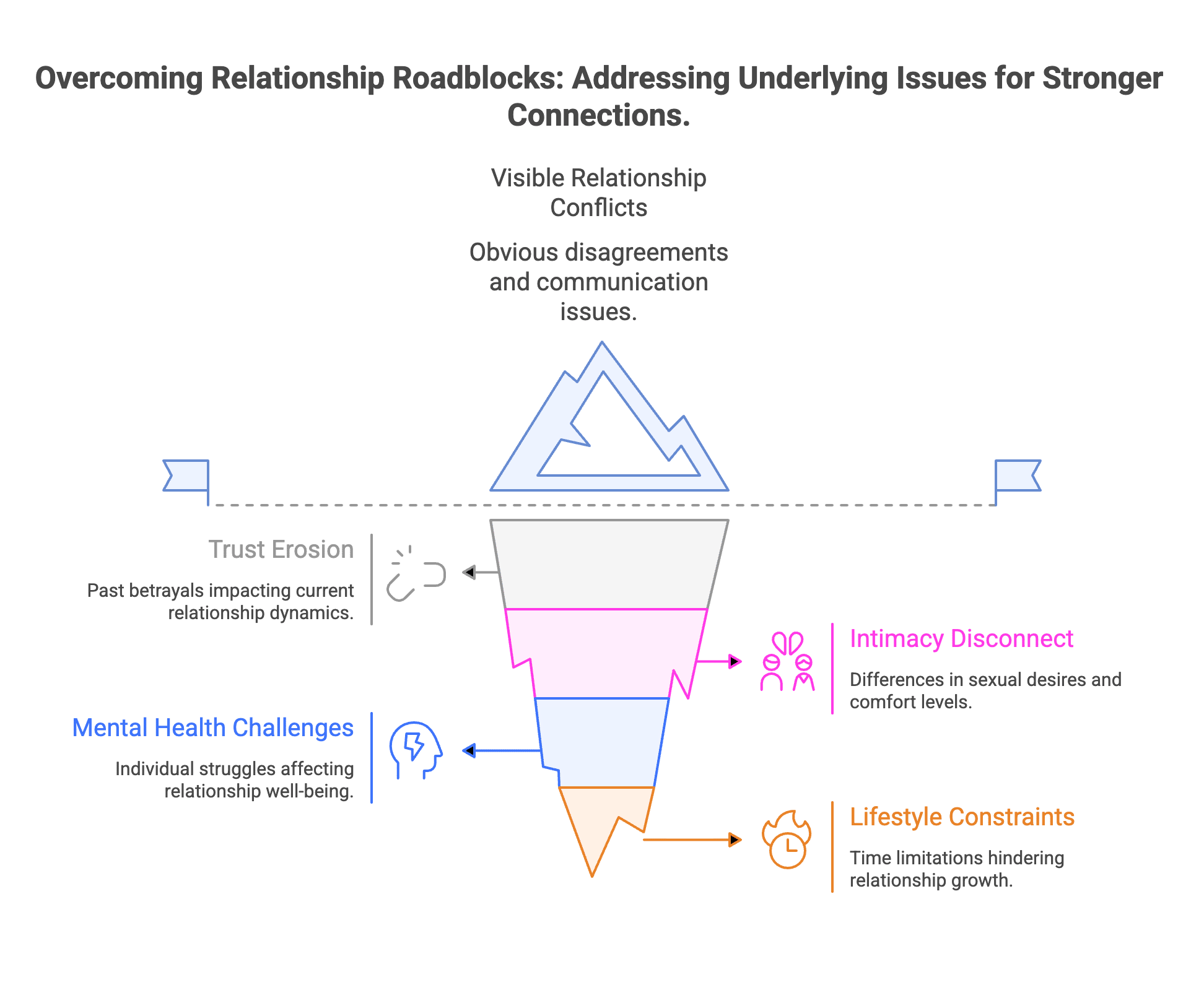
Common roadblocks—and how we handle them
High conflict or stonewalling. We slow the pace, shorten turns, and add time‑outs so talks stay safe.
After a breach of trust. We help you stabilize first, set boundaries, and then build a stepwise plan to share truth, show reliability, and rebuild closeness at a pace that protects both partners.
Sex and intimacy differences. Once safety is stronger, we add gentle exercises around desire, comfort, and touch so pressure drops and connection grows.
Mental health or substance concerns. If anxiety, depression, trauma, or alcohol use are part of the picture, we integrate tools or coordinate with individual therapy to support the couple work.
Busy schedules and travel. We use telehealth or 75‑minute sessions to keep momentum when life is full.
Charlotte logistics that make this doable
- Format: in‑person in South End or secure telehealth; hybrid is welcome.
- Session length & cadence: 50‑minute standard; 75‑minute intensives available; start weekly, taper after several months as improvements hold.
- Cost & coverage: we’re out‑of‑network and provide superbills so you can seek reimbursement.
- Prep: complete simple online forms before your first visit so the session can focus on you.
- Privacy for telehealth: pick a private room, use headphones, and schedule breaks if you feel flooded.
Is couples counseling a fit for us right now?
- You’re willing to try new conversations, pause when flooded, and show basic respect—even when upset.
- You want to improve the relationship, not keep score or “win.”
- Safety first: if there is ongoing violence or coercive control, we’ll help you connect with safer, specialized resources before couples work.
Getting started in South End with the Therapy Group of Charlotte
You don’t need perfect words—bring yourselves and your hopes. We’ll help with the rest. Request a time for couples counseling (also called marriage counseling or relationship counseling) in our South End office or online, and we’ll set up your first session and a simple plan for the next few weeks.
Couples Counseling FAQ
What types of couples can benefit from couples counseling?
Couples counseling can help all types of intimate relationships, regardless of marital status or sexual orientation. Whether you are dating, engaged, married, or co-parenting, relationship therapy can support you in addressing relationship challenges and improving communication skills. Preventative maintenance in counseling can strengthen a healthy relationship and build skills for the future.
Who provides couples counseling and what qualifications do they have?
Couples therapy is conducted by licensed therapists such as licensed marriage and family therapists (LMFTs), licensed professional counselors (LPCs), psychologists, or clinical social workers. These mental health professionals specialize in marital and family therapy and are trained to help couples navigate relationship distress and personal challenges. Most couples experience periods of distress and may find therapy beneficial at any stage of their relationship.
How does online couples therapy work?
Online couples counseling offers flexible and convenient therapy services via secure telehealth platforms. Couples can participate in virtual therapy sessions from different locations, making it easier to fit therapy into busy schedules. Online marriage counseling is as effective as in-person therapy and often includes video, audio, and messaging options. Online couples therapy is as effective as in-person therapy in promoting healthy relationships.
What issues can couples therapy address?
Couples therapy helps with a wide range of relationship issues including communication breakdown, trust rebuilding, conflict resolution skills, intimacy concerns, and significant life transitions such as parenting or financial stress. It also supports couples coping with mental health conditions that affect their relationship. Frequent arguments or stuck conflicts indicate underlying issues in the relationship.
Can individuals seek therapy alone if their partner is unwilling?
While couples therapy typically involves both partners, sometimes one partner seeks therapy individually to work on personal growth or to better understand relationship patterns. Licensed therapists can provide guidance on whether individual therapy or combined approaches are most appropriate.
What is premarital counseling and who should consider it?
Premarital counseling is a form of relationship therapy designed for engaged couples to build a healthy foundation before marriage. It focuses on communication skills, conflict resolution, and aligning relationship goals. Online premarital counseling offers a convenient way for couples to prepare for their future together.
How long does couples counseling usually last?
Therapy sessions typically last 50 minutes and may occur weekly or biweekly. The length of treatment varies depending on the couple’s needs and goals, with some couples benefiting from short-term therapy while others engage in longer-term counseling to address complex issues.
Are there group therapy options for couples?
Yes, group therapy for couples provides a supportive environment where multiple couples can share experiences and learn from each other under the guidance of a licensed therapist. This format can enhance empathy, improve family dynamics, and foster healthy communication skills.
How do therapists tailor treatment plans for couples?
Licensed therapists develop individualized treatment plans based on the couple’s unique relationship patterns, goals, and challenges. These plans may incorporate evidence-based approaches such as cognitive behavioral therapy, dialectical behavior therapy, emotionally focused therapy, or solution-focused therapy to promote relationship satisfaction and personal growth.