
Therapy for LGBT Individuals: Healing from Religious Trauma in Charlotte
If you grew up hearing that your sexual orientation or gender identity was sinful, shameful, or something to hide, those messages may still affect you today. Religious trauma happens when religious teachings, communities, or practices cause lasting harm—particularly when they reject or try to change who you are. Therapy for LGBT individuals can help you process this pain, separate harmful religious messages from your own beliefs, and build a life that honors both your identity and your values.
What is religious trauma?

Religious trauma occurs when religious beliefs, practices, or religious communities cause psychological harm—especially when they condemn, reject, or attempt to change your sexual orientation or gender identity. Many mental health professionals now recognize a pattern of symptoms sometimes called religious trauma syndrome (RTS)—experiences common among those who have been harmed by controlling or authoritarian religions.
Religious trauma from conversion practices is linked to depression, anxiety, PTSD, and increased risk of suicidal thoughts. Symptoms often associated with religious trauma syndrome include cognitive confusion, anxiety, depression, and social isolation—particularly common among LGBTQ individuals who faced religious indoctrination that condemned their identities.
This trauma can come from many forms of religious contexts. Maybe you heard sermons describing LGBTQ people as sinful or broken. Perhaps your family members sent you to conversion therapy or pressured you to “pray away” your identity. Some people experience formal religious practices aimed at changing their orientation, while others absorb more subtle messages from fundamentalist religion—being excluded from religious roles, watching religious leaders embrace other members’ relationships while ignoring yours, or hearing that you must choose between your faith and your authentic self.
The impact often goes deeper than specific events. Many LGBTQ people internalize religious shame from purity culture and religious doctrine that becomes a constant inner voice of criticism and unworthiness. Even after leaving a non-affirming religious community, those messages can persist for years, affecting self-esteem and one’s ability to live authentically. This is particularly true for those raised in authoritarian religions that emphasized eternal damnation for LGBTQ identities.
How does religious rejection affect mental health?
The effects are significant and well-documented. Faith community rejection is associated with depression, anxiety, sleep problems, and high blood pressure. LGBTQ individuals who experience religious rejection often have less social support, making it harder to cope with mental health challenges and contributing to various mental health issues.
You might notice persistent feelings of shame about your LGBTQ identity, even when you intellectually know there’s nothing wrong with being who you are. Some people describe feeling “spiritually homeless”—disconnected from the faith traditions that once gave their life meaning. Others struggle with fear that they’re fundamentally unlovable or that happiness isn’t possible for people like them. These mental health challenges are compounded by societal pressures and lack of acceptance in religious environments.
Religious trauma affects relationships in complex ways. You might have difficulty trusting others, anticipating rejection before it happens. Some LGBTQ people avoid romantic relationships entirely, having internalized the message that their love is wrong. Others struggle with intimacy, unable to fully believe they deserve connection and partnership. The impact on your social network can be profound, especially when family members remain connected to the religious community that rejected you.
Research links the religious environment to sexual minority mental health outcomes, showing how societal pressures and lack of acceptance compound individual experiences of rejection. The greater risk of mental disorders among LGBTQ individuals who face religious rejection reflects these compounded stressors.
In our work with LGBTQ clients in Charlotte, we see how Bible Belt culture can intensify religious trauma. Many clients carry deep shame from being told their identity conflicts with their faith. The work involves helping them distinguish between harmful religious teachings and their actual values—recognizing they can honor their spirituality while embracing who they are.
What are conversion practices and why are they harmful?
Conversion practices (sometimes called “conversion therapy” or “reparative therapy”) are attempts to change someone’s sexual orientation or gender identity. These range from formal therapy programs to informal family or religious community interventions. Some use talk therapy approaches, while others involve prayer, fasting, or even physical punishment promoted by religious leaders.
Conversion practices are linked to higher rates of depression, anxiety, and PTSD. They’re based on the false premise that LGBTQ identities are disorders needing correction—a view rejected by the American Psychiatric Association and all major medical and mental health organizations. The Diagnostic and Statistical Manual does not classify LGBTQ identities as mental disorders.
The harm comes not just from the practices themselves but from the underlying message: that who you are is so unacceptable it must be changed. This damages self-worth for years or even decades and can contribute to what many clinicians recognize as religious trauma syndrome. Many people who underwent conversion practices describe lasting trauma, including difficulty forming healthy relationships and persistent self-hatred. The experience can lead to mood disorders, substance use, eating disorders, and other mental health concerns.
Even informal family pressure to change your identity—being told to “try harder” to be straight or conform to gender norms—can have similar effects. The constant message that you’re not acceptable creates what researchers call moral injury: a deep sense that something is fundamentally wrong with you. This is especially damaging when combined with messages about eternal damnation.
Is religious trauma CPTSD?
Religious trauma shares many symptoms with complex PTSD (C-PTSD), though religious trauma syndrome is not yet formally recognized as a distinct diagnosis in the Diagnostic and Statistical Manual. Both conditions involve prolonged exposure to trauma and result in similar symptoms: anxiety, depression, difficulty with emotional regulation, and problems with self-esteem and relationships.
Complex PTSD typically develops from ongoing childhood trauma or adverse religious experiences during developmental years. Religious trauma, particularly for LGBTQ individuals raised in fundamentalist religion or authoritarian religions, often involves years of harmful messaging during critical developmental tasks. Resources like the Religious Trauma Institute and organizations like Journey Free provide information about understanding religious trauma as a form of complex trauma.
Many mental health professionals trained in trauma-informed care treat religious trauma using approaches similar to those for C-PTSD. This includes working with your nervous system, processing traumatic memories, and helping you rebuild a sense of safety and identity. Whether we call it religious trauma syndrome or complex PTSD, the suffering is real and deserves specialized clinical practice.
Can I heal from religious trauma?
Yes. Healing from religious trauma is possible, though it takes time and often requires support from a mental health professional who understands both LGBTQ issues and religious trauma. Finding a clinical mental health counselor or licensed clinical social worker with specialized training in this area is essential.
First, you’ll work on separating harmful religious beliefs from your own authentic values. An affirming therapist can help you examine which messages serve you and which are echoes of trauma from religious indoctrination. This isn’t about rejecting spirituality—many people find ways to reclaim or reconstruct their faith in affirming religious contexts. It’s about giving yourself permission to question religious doctrine that caused harm. This process of identity exploration happens at your own pace in a validating space.
Second, therapy helps you process grief. Many LGBTQ people grieve multiple losses: the religious community that rejected them, relationships with family members who chose their beliefs over connection with you, the sense of spiritual certainty they once had, and sometimes their faith itself. LGBTQ-affirmative therapy provides space to acknowledge and work through these losses while building resilience.
Third, you’ll build self-compassion and challenge internalized shame from religious trauma. This means learning to treat yourself with the kindness you’d offer a friend, recognizing that religious trauma wasn’t your fault, and understanding that your identity is valid regardless of what religious leaders said. Building self-acceptance is central to healing.
Organizations like Journey Free and the Reclamation Collective offer additional peer support resources for those healing from religious trauma, providing community alongside professional therapy.
What does therapy for religious trauma look like?
Therapy creates a safe space to explore painful experiences without judgment. Your therapist—whether a licensed clinical social worker, clinical mental health counselor, psychologist, or other mental health professional—won’t tell you what to believe about religion or spirituality. Instead, they’ll help you figure out what feels authentic to you. Some people maintain their faith while finding affirming religious communities. Others step away from organized religion entirely. Many fall somewhere in between, holding onto certain spiritual practices while releasing religious beliefs that cause harm.
In sessions, you might work on identifying specific religious messages from religious leaders and religious communities that still affect you. What were you taught about LGBTQ people? About yourself? How do those teachings show up in your thoughts and behaviors today? An affirming therapist helps you recognize when old religious programming from purity culture or religious indoctrination is influencing current decisions. This supportive environment allows for genuine self-discovery and personal growth.
Trauma-informed care recognizes that religious rejection creates lasting impacts similar to other forms of trauma. PTSD symptoms and complex PTSD are more common among LGBTQI+ adults who experienced religious rejection from authoritarian religions, particularly those who underwent conversion practices. Your therapist might use evidence-based approaches like cognitive-behavioral therapy, dialectical behavior therapy, or acceptance and commitment therapy to help you process traumatic memories and develop healthier coping strategies for managing life’s challenges.
Many therapists trained in trauma-focused therapy also incorporate holistic therapy approaches that work with your nervous system and life experiences to support healing.
Group therapy can be particularly powerful for religious trauma. Connecting with other LGBTQ people who’ve had similar adverse religious experiences reduces isolation and helps you realize you’re not alone. The LGBTQ community offers tremendous support during this healing process. Hearing how others have worked through faith, family members, and identity issues in various religious contexts can open up possibilities you hadn’t considered.
Journey Free and similar organizations provide peer support groups specifically for religious trauma, which can complement individual therapy.
We often tell clients that healing from religious trauma doesn’t mean forgetting what happened—it means those experiences no longer control how you see yourself. Some people find their way back to faith in affirming communities. Others create entirely new spiritual practices. What matters is building a relationship with yourself that isn’t based on shame.
How do I deal with religious trauma?
Dealing with religious trauma involves several key steps:
Seek specialized support. Look for mental health professionals with specialized training in both LGBTQ-affirmative therapy and religious trauma. Not all therapists understand the specific dynamics of religious trauma, particularly as it affects LGBTQ individuals who faced rejection from fundamentalist religion or authoritarian religions.
Build a supportive environment. Surround yourself with people who affirm your LGBTQ identity. This might mean creating a new social network outside your previous religious community. Many people benefit from connecting with peer support organizations or LGBTQ-affirming religious communities in Charlotte, NC.
Practice self-compassion. Challenge the critical inner voice that developed from religious indoctrination. Therapy helps you recognize when you’re being harder on yourself than you would be on loved ones. Building self-worth takes time, but it’s essential for healing.
Consider evidence-based approaches. Dialectical behavior therapy, cognitive-behavioral therapy, and motivational interviewing have shown effectiveness in treating trauma symptoms. Some people also benefit from holistic therapy that addresses both mental and physical aspects of trauma stored in the nervous system.
Allow time for identity exploration. Leaving a controlling religious community often means rethinking fundamental aspects of your identity. Therapy provides a safe space for this self-discovery process, helping you figure out your true self beyond what religious doctrine dictated.
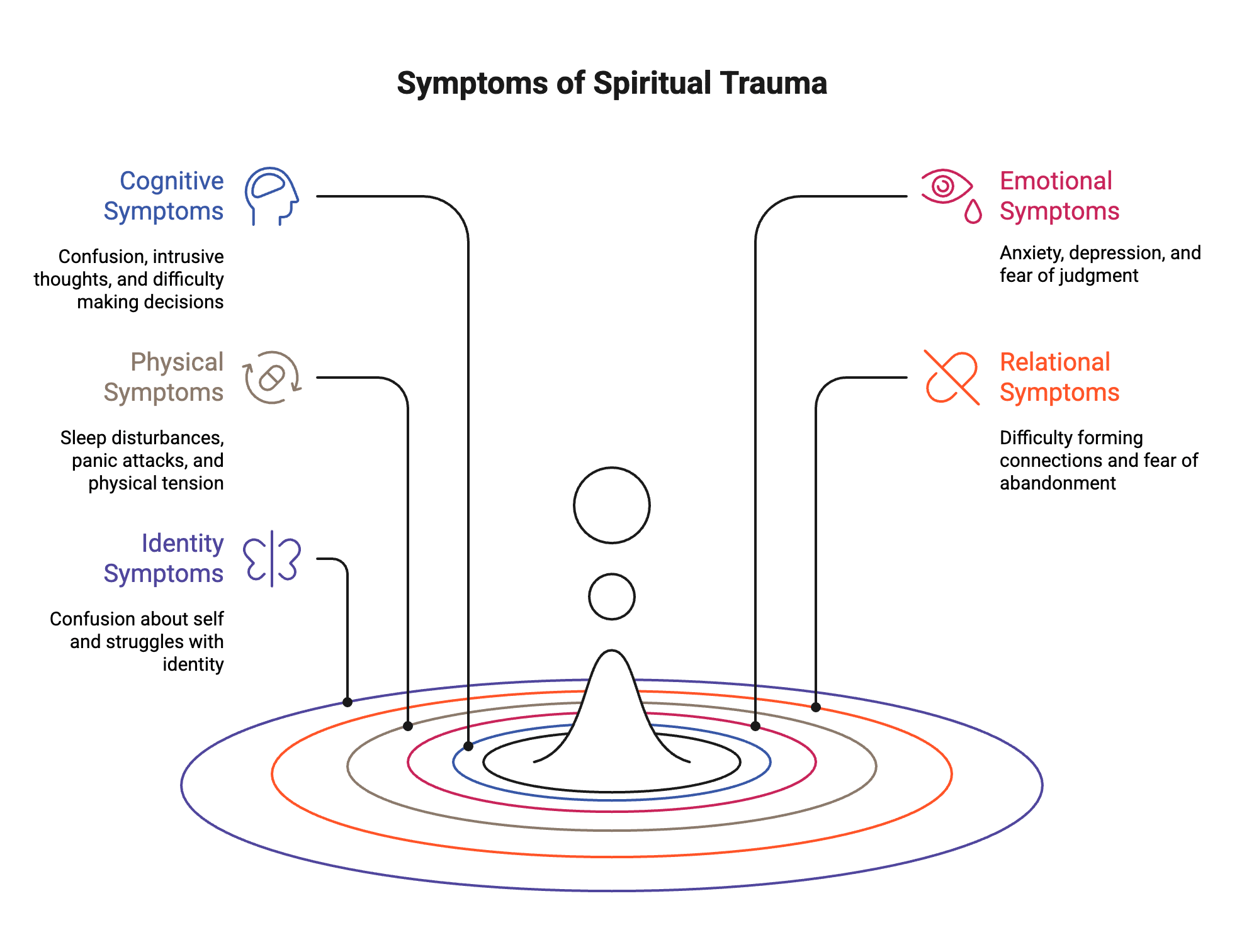
What are the symptoms of spiritual trauma?
Spiritual trauma (another term for religious trauma) can present with many symptoms that affect your mental health and daily life:
Cognitive symptoms may include confusion about beliefs, difficulty making decisions without external authority, and intrusive thoughts about religious teachings or eternal damnation. You might experience “thought stopping” where you shut down certain questions because they were forbidden in your religious context.
Emotional symptoms may include anxiety, depression, intense guilt or shame, difficulty trusting your own feelings, and fear of being watched or judged. Many people with religious trauma struggle with social anxiety, particularly in situations that trigger memories of religious communities.
Physical symptoms can include changes in your nervous system response, sleep disturbances, panic attacks, and somatic symptoms from years of suppressing your authentic self. Religious trauma can manifest in many forms of physical tension or illness.
Relational symptoms may include difficulty forming intimate connections, fear of abandonment, problems with authority figures, and complicated relationships with family members who remain in the religious community. You might struggle with obsessive-compulsive disorder related to religious rituals or develop eating disorders connected to messages about the body and purity culture.
Identity symptoms may include confusion about who you are apart from religious roles, difficulty knowing what you actually believe versus what you were taught, and struggles with sexual identity or gender identity after years of suppression. Childhood trauma from religious environments can affect developmental tasks in ways that persist into adulthood.
If you’re experiencing these symptoms, know that help is available from mental health professionals who understand religious trauma.
How do I handle family relationships when religion is involved?
This is one of the most painful aspects of religious trauma. Many LGBTQ people face family rejection rooted in religious beliefs taught by religious leaders and reinforced by religious communities. Parents might refuse to acknowledge your identity or partner, exclude you from family gatherings, or maintain relationships only if you hide who you are. These family dynamics represent unique challenges that require specialized support.
Therapy can help you work through these difficult situations. You’ll develop coping skills for setting boundaries that protect your well-being while deciding what kind of relationships feel sustainable with family members. For some people, that means limited contact with those who won’t respect their identity. Others find ways to maintain connections despite disagreement, recognizing that loved ones are also influenced by religious indoctrination.
Your therapist can help you process the grief of family rejection without blaming yourself. Faith community rejection reduces social support, which makes it even more important to build supportive relationships elsewhere. Many LGBTQ people create “chosen families”—networks of friends and community members who fully accept and celebrate them. Building these connections supports your well-being and helps you feel empowered in your life.
In Charlotte, NC, where religious culture is prominent, these dynamics can feel especially intense. You might encounter religious messaging regularly, even outside your family. Therapy helps you develop resilience for handling these experiences without internalizing harmful messages. Therapy in Charlotte provides context-aware support that understands the local religious environment and its impact on LGBTQ individuals.
Can I be LGBTQ and still have faith?
Absolutely. Many LGBTQ people maintain meaningful spiritual lives while fully embracing their identity. The key is finding or creating religious contexts that affirm rather than reject who you are. Your sexual identity and faith don’t have to be in conflict—that’s a false choice created by some authoritarian religions.
Affirming religious communities can be protective for mental health. When LGBTQ people find religious communities that celebrate their identities, they can experience spiritual connection without the trauma of rejection. Charlotte has affirming congregations across different denominations—churches, synagogues, and other faith communities that explicitly welcome LGBTQ people. These communities support both gender identities and sexual orientations without attempting to change who you are.
Some people reconstruct their faith on their own terms, keeping elements that feel meaningful while releasing religious doctrine that caused harm. Others explore different spiritual traditions entirely. There’s no single right way to approach identity and faith—therapy helps you find your own path through this identity exploration, free from the religious indoctrination of fundamentalist religion.
Your therapist can support you in exploring questions like: What role do you want spirituality to play in your life? Which religious beliefs and spiritual practices feel nourishing versus harmful? How can you honor both your identity and your values? This process often involves life transitions as you move from restrictive religious communities to more affirming contexts.
Organizations like Journey Free offer resources for those reconstructing faith after leaving controlling religious communities, helping you explore spirituality on your own terms.
What other challenges might I face?
Religious trauma often intersects with other mental health challenges. Many LGBTQ people dealing with religious trauma also experience anxiety, depression, substance use, eating disorders, obsessive-compulsive disorder, borderline personality disorder, or mood disorders. Affirmative therapy addresses these conditions while understanding their connection to religious rejection and minority stress.
For example, anxiety might be rooted in hypervigilance developed from years of monitoring your behavior to avoid condemnation from religious leaders. Depression might stem from the hopelessness of believing you must choose between your identity and your religious community. Substance use might have started as a way to cope with shame or numb the pain of rejection. Sexual abuse in some religious contexts can compound trauma for LGBTQ individuals.
Your therapist will work with you on all aspects of your mental health, recognizing how religious trauma affects your overall well-being. This might include building coping strategies, processing traumatic memories, developing emotional awareness, and creating healthier ways to manage difficult feelings. Some therapists also incorporate dialectical behavior therapy or holistic therapy approaches depending on your needs, taking a trauma-informed approach to all aspects of treatment.
Mental health professionals trained in treating religious trauma understand how adverse religious experiences affect developmental tasks and continue impacting adult life in many forms.
What is the best therapy approach for LGBTQ individuals with religious trauma?
LGBTQ-affirmative therapy combined with trauma-informed care offers an effective approach for religious trauma. This means working with mental health professionals who understand both the specific challenges LGBTQ individuals face and the complex dynamics of religious trauma.
Effective therapeutic approaches include:
- Cognitive-behavioral therapy to challenge negative thought patterns from religious indoctrination
- Dialectical behavior therapy to build coping skills for managing intense emotions
- Trauma-focused therapy specifically addressing religious trauma and complex trauma symptoms
- Holistic therapy that works with your nervous system and recognizes connections between mind and body
- Motivational interviewing for exploring ambivalence about identity and beliefs
The right therapist will have specialized training in LGBTQ issues and religious trauma, creating a safe space where you can explore your experiences without judgment. Look for therapists who explicitly offer LGBTQ-affirming therapy and have experience working with religious trauma—not all therapists support LGBTQ identities or understand the specific dynamics of leaving authoritarian religions.
Resources like the Religious Trauma Institute provide information for finding qualified therapists, and Journey Free offers directories of mental health professionals with training in treating religious trauma.
How do I find a therapist who understands religious trauma?
Look for mental health professionals with specialized training in both LGBTQ-affirmative therapy and religious trauma. The right therapist will understand how religious rejection specifically affects LGBTQ people and won’t minimize your experiences or push you toward reconciliation with harmful religious beliefs. LGBTQ therapists or affirming therapists with continuing education in religious trauma are ideal.
Many therapists in Charlotte now offer online therapy in addition to in-person sessions, giving you more options for finding someone who’s a good fit. Whether you’re in South End, Dilworth, Myers Park, or elsewhere in Charlotte, NC, you can access therapy that addresses both your LGBTQ identity and your religious trauma.
In your first appointment, notice how the therapist talks about religion and spirituality. Do they respect your experiences without imposing their own religious beliefs? Do they understand religious trauma and the specific dynamics of leaving fundamentalist religion or authoritarian religions? Do they recognize the unique challenges LGBTQ people face in religious contexts? A welcoming space where you feel empowered to explore your experiences is essential for lasting change. The therapeutic relationship should offer a nonjudgmental space for your healing.
Resources for finding qualified therapists include:
- Psychology Today directory (filter for religious trauma and LGBTQ specialization)
- Journey Free therapist resources
- Religious Trauma Institute information
- Local LGBTQ organizations like PFLAG Charlotte
Organizations like Journey Free and the Reclamation Collective offer peer support that can complement professional therapy, providing community with others who understand religious trauma.
We approach religious trauma with deep respect for both the pain it causes and the complexity of faith for many LGBTQ people. Our goal isn’t to tell you what to believe—it’s to help you heal from harmful experiences in religious communities and build a life where your identity and values can coexist authentically.
What does healing look like?
Healing from religious trauma doesn’t happen overnight. You’ll have weeks when old shame patterns feel distant, and others when messages from religious leaders or purity culture resurface. That’s normal and doesn’t mean you’re failing.
You might notice gradual shifts: feeling less anxiety when religion comes up in conversation, setting boundaries with family members who remain in your former religious community, exploring spirituality without fear of eternal damnation, or simply feeling more at peace with who you are. Some people find they can engage with affirming religious communities again. Others discover meaning in entirely secular lives. Each person’s path supports their unique process toward self-acceptance, free from religious indoctrination.
The goal isn’t to eliminate all pain or completely resolve your relationship with religion. It’s to build resilience so religious trauma no longer controls your sense of self-worth. To recognize that your LGBTQ identity is valid regardless of what religious leaders taught you. To create space for healing, personal growth, and authentic living where you feel heard and supported. To complete the developmental tasks that were disrupted by religious trauma during childhood or adolescence.
Journey Free describes this process as moving from “recovery” to “reclamation”—not just healing from what was taken, but actively building the life you want. This might involve exploring your true self, developing self-worth independent of religious doctrine, and creating a sense of meaning that honors your authentic identity.
Find Support for Religious Trauma in Charlotte
If you’re struggling with religious trauma, family rejection, or the challenge of reconciling your LGBTQ identity with your religious background, therapy can help. The Therapy Group of Charlotte provides LGBTQ-affirmative therapy in a supportive environment where your experiences are validated and your healing is centered. Our team includes mental health professionals who understand the unique challenges of religious trauma in the LGBTQ community and offers affirming care that respects your identity. Schedule an appointment to begin processing religious trauma and building greater well-being.
Disclaimer: This article is for educational purposes only and is not a substitute for professional medical advice, diagnosis, or treatment. Always seek the advice of your physician or qualified mental health provider with any questions you may have regarding a medical or mental health condition. If you are in crisis or experiencing thoughts of self-harm, please call 988 (Suicide and Crisis Lifeline) or go to your nearest emergency room.
