

Resilience in childhood isn’t something children are born with—it’s a set of skills they learn over time. Teaching resilience means helping children build emotional and practical tools to bounce back from challenges, manage stress, and adapt when life doesn’t go as planned. Research shows that resilience in children can be nurtured through supportive relationships, problem-solving opportunities, and environments that promote healthy development.
Parents and caregivers play the most critical role in this process. The good news? You don’t need special training. By understanding what builds resilience in children and making intentional changes in how you interact with your child during early childhood, you can help them build resilience and develop skills that serve them throughout their lives.
Why Is Resilience Important for Children?
Resilience helps children manage difficult emotions and recover from setbacks, which directly impacts their mental health and well-being. When children develop self regulation and coping skills through early childhood experiences, they’re better equipped to handle stress, adapt to change, and work through challenges without becoming overwhelmed.
The research is clear: resilient children show better mental health outcomes and are less likely to develop anxiety, depression, or other mental health problems later in life. These protective factors don’t just help in early childhood—they create a foundation for lifelong health and positive development across all domains of human development and early childhood education.
Beyond mental health, resilience influences how children perform in school, build relationships, and navigate everyday challenges. Children who can bounce back from disappointments tend to be more engaged learners, better problem solvers, and more confident in their abilities. Over the past five decades, resilience research has consistently shown that building these capacities in early childhood and supporting positive child development leads to better outcomes throughout the lifespan.
What Makes Children Resilient?
Resilience develops through supportive relationships, personal skills, and environmental factors. It’s not about one single trait but a collection of protective factors and resilience factors that work together to support child development.
The most important protective factor is having at least one stable, caring relationship with an adult. This might be a parent, grandparent, teacher, or other family members. Strong relationships with caregivers provide the foundation children need to feel safe, supported, and capable of handling challenges.
Developmental resilience science has identified other key protective factors that promote healthy development:
- Self regulation skills that help children manage emotions and impulses
- Problem-solving skills that encourage creative thinking and persistence
- Self-efficacy—confidence in their own abilities to handle situations
- Social support from peers, teachers, and community settings
- Routines and structure that provide predictability during uncertain times
Early childhood is a particularly critical period for building these protective systems. Brain development during these early childhood years creates neural pathways that influence how children respond to stress throughout their lives. This developmental timing matters significantly for future development and the child’s ability to navigate adversity.
Key Insight: The presence of just one supportive, consistent adult can make all the difference in a child’s ability to overcome adversity and build resilience.
How Do Children Learn Resilience?
Children build resilience by experiencing manageable challenges and learning how to navigate them with support. This doesn’t mean shielding them from all difficulties—it means being present as they work through age-appropriate struggles that foster positive adaptation.
The process of promoting resilience involves several elements. First, children need opportunities to face challenges—trying a new activity, working through a disagreement, or handling disappointment when things don’t go their way. These experiences help children develop skills essential for human development.
Second, they need supportive relationships to process these experiences. Parental warmth and responsiveness can buffer the negative effects of toxic stress and help children develop healthy coping skills. Positive parenting practices that include warmth and structure are among the most effective ways to build resilience in children.
Third, children benefit from developing self regulation—the ability to manage emotions, focus attention, and exercise self control. These self regulation skills are essential for early child development and a child’s ability to overcome adversity in various contexts.
Modeling Resilient Behavior
Children learn by watching how adults handle stress. When you model healthy coping strategies—deep breaths when frustrated, talking through problems, asking for help—you’re teaching your child that challenges are normal and manageable. This modeling is a form of positive parenting that supports resilience in children.
What Are Examples of Resilient Children?
A resilient child might initially feel upset when they don’t make the soccer team but then finds another activity they enjoy. They understand that uncomfortable emotions won’t last forever and can work through disappointment without it derailing their well-being. This demonstrates positive adaptation in action.
Another example: a child who struggles with difficult homework might feel frustrated at first but eventually tries different approaches. Instead of giving up, they use problem-solving skills—asking for help, breaking the task into smaller steps, or taking a break and returning with fresh perspective.
Resilient children also show flexibility when plans change unexpectedly. If a playdate gets canceled, they can adapt to the new situation without excessive distress. They’ve learned that life doesn’t always go according to plan, and that’s okay. These examples illustrate the resilience framework that many children can develop with proper support.
These examples share common threads: resilient children experience normal emotional reactions to challenges but have developed coping skills that help them recover and move forward. Research suggests that such children often had caregivers who helped them build resilience through consistent support.
What Causes Low Resilience in Children?
Low resilience often develops when children face chronic stress without adequate support or protective factors. Understanding these risk factors and protective factors helps parents recognize when children might need additional help, which is an important focus in both child psychology and pediatric practice.
Adverse childhood experiences can significantly impact resilience and child development. Research on childhood adversity and early childhood adversity shows that chronic exposure to stress—family instability, poverty, or maltreatment—can affect brain development and disrupt healthy child development, making it harder for children to develop self regulation.
Specifically, stress in early childhood can alter how the developing child’s brain responds to challenges. Toxic stress from extreme adversity without protective systems can disrupt normal child development and brain development. This doesn’t mean resilience can’t be built, but it may require more intentional parenting interventions and support.
Other factors that can contribute to low resilience include:
- Inconsistent or harsh parenting that doesn’t provide emotional security or teach parenting skills
- Mental illness in caregivers that affects their ability to provide responsive care
- Lack of social support or community resources
- Extreme adversity without adequate protective systems
- Traumatic events without proper support for healing
Many children who experience these challenges can still develop strong human resilience, especially with tailored interventions and supportive relationships. The goal isn’t to eliminate all stress but to ensure children have protective factors they need. This is a key insight from systematic review research in clinical psychology and developmental psychopathology.
What Are the 7 C’s of Resilience in Children?
The 7 C’s resilience framework identifies seven components that promote healthy development: competence, confidence, connection, character, contribution, coping, and control. This framework has guided promoting resilience efforts across multiple sectors of child development work.
Competence refers to skills children need to handle situations effectively—problem solving skills, academic abilities, and social skills. When children feel competent, they’re more willing to overcome challenges.
Confidence is solid belief in one’s abilities, what resilience researchers call self efficacy. Children develop confidence and self efficacy through experiencing success, receiving encouragement, and learning that effort leads to growth.
Connection emphasizes supportive relationships with family members, friends, and community. These bonds provide the security children need to take risks and try new things, which supports positive development.
Character involves developing empathy, a sense of right and wrong, and a moral compass. Children with strong character make decisions aligned with their values, even under pressure.
Contribution means helping children understand they have something valuable to offer. This sense of purpose builds self-efficacy and motivation, key resilience factors.
Coping refers to healthy strategies for managing stress—deep breathing, talking about feelings, physical activity, or seeking support from others. Active coping skills help children navigate difficulties.
Control involves helping children understand what they can and cannot control. When children recognize they have agency over their responses—even when they can’t control external circumstances—they develop greater resilience in children.
Key Insight: You don’t need to master all 7 C’s at once. Focus on strengthening one or two areas where your child needs the most support, and build from there.
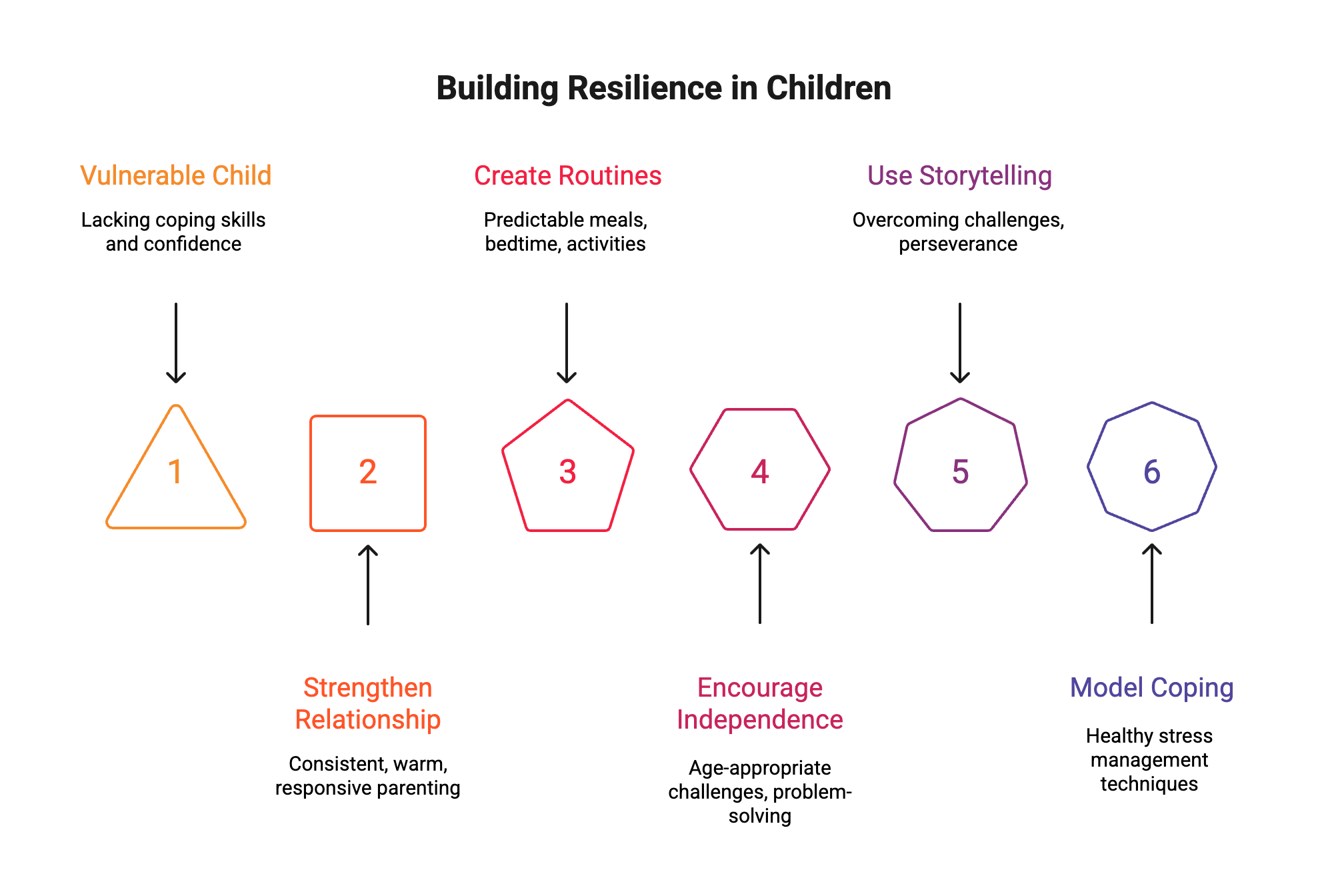
How Can Parents Build Resilience in Their Children?
The most effective way to nurture resilience is through consistent, warm, and responsive parenting. Positive parenting is often the single most significant factor that boosts resilience in children and supports healthy child development.
Strengthen Your Relationship
Start by strengthening your relationship with your child. Spend quality time together, listen without judgment, and show you’re there even during difficult moments. This secure attachment provides the foundation for all other efforts to build resilience.
Create Predictable Routines
Create routines for meals, bedtime, and family activities. These routines provide security and help children develop self-control and self-regulation skills. Even during stressful times, maintaining some predictability helps children feel grounded and supports their overall mental health.
Encourage Independence and Problem-Solving
Encourage independence by allowing your child to face age-appropriate challenges. Instead of immediately solving every problem, ask “What do you think you could try?” or “How might you handle this?” This builds competence, confidence, and problem-solving skills that are essential resilience factors.
Use Storytelling as a Tool
Storytelling can be powerful for building resilience. Share stories about times you overcame challenges, read books about characters who persevere, or help your child create narratives about their own experiences. This helps them make sense of difficulties and see challenges as opportunities for positive development.
Model Healthy Coping Strategies
Teach and model healthy coping strategies. Show your child how you manage stress through deep breathing, physical activity, talking about feelings, or taking breaks when overwhelmed. Name your own emotions and explain how you’re working through them. This modeling supports their developing parenting skills for future use.
Support Mental Health and Well-Being
Pay attention to your child’s mental health. If you notice persistent anxiety, depression, or behavioral changes, seek support from qualified professionals in pediatric practice or clinical psychology. Early intervention can improve outcomes for children struggling with mental health problems and can prevent more serious mental illness.
Key Insight: Building resilience isn’t about creating perfect, stress-free childhoods. It’s about equipping children with tools to handle the inevitable challenges life brings—a core principle of health promotion in early childhood.
What Are the 4 Types of Resilience?
Resilience research identifies four main types: physical, mental, emotional, and social resilience. Understanding these dimensions from developmental perspectives helps parents support the full range of their child’s development and well-being.
Physical resilience involves the body’s ability to handle stress and recover from illness. This includes healthy habits around sleep, nutrition, and physical activity that support well-being and are important protective factors.
Mental resilience refers to cognitive flexibility and adapting thinking when circumstances change. Children with strong mental resilience can shift perspectives, learn from mistakes, and develop creative solutions—capabilities that contribute to positive outcomes in school and beyond.
Emotional resilience is the capacity to process difficult emotions without becoming overwhelmed. This helps children recognize their feelings, understand that emotions are temporary, and use healthy coping strategies. Emotional resilience is particularly important for mental health across the lifespan.
Social resilience involves building supportive relationships, navigating social challenges in community settings, and drawing strength from connections with other family members and peers. Children with strong social resilience can seek help when needed and offer support to others.
All four types work together and reinforce each other. A child who gets adequate sleep is better able to manage frustration, which helps them maintain friendships and perform well in school—demonstrating how different domains of human development interact.
When Should You Seek Professional Support?
While all children benefit from resilience-building practices, some situations call for additional professional support. If your child has experienced significant trauma or childhood adversity, shows persistent mental health problems, or struggles despite your efforts at home, reaching out to a therapist can make a significant difference in improving health outcomes.
Developmental research shows that early intervention is particularly important for children threatened by chronic adversity. Professional support can include parenting interventions that strengthen parenting skills, cognitive behavioral strategies, or trauma-focused care tailored to your child’s specific needs. These preventive interventions can significantly improve mental health and positive development.
Resilience literature across world psychiatry and systematic review studies consistently shows that high-risk children benefit most from early, comprehensive support that addresses multiple protective systems in their lives.
Get Support in Charlotte
If you’re looking for support in building resilience in your child, the therapists at Therapy Group of Charlotte are here to help. Schedule an appointment to get started with evidence-based strategies tailored to your family’s needs.
Disclaimer: This article is for educational purposes only and is not a substitute for professional medical advice, diagnosis, or treatment. Always seek the advice of your physician or qualified mental health provider with any questions you may have regarding a medical or mental health condition. If you are in crisis or experiencing thoughts of self-harm, please call 988 (Suicide and Crisis Lifeline) or go to your nearest emergency room.